Brother CS5055 Sewing Machine Review: Worth It? (November 2026)
The Brother CS5055 is a solid computerized machine for beginners who want a wide stitch menu and an LCD screen. Buy the Brother CS5055PRW instead if you want the same easy threading and a lower price tier.
On this page (9 sections)
- The Brother CS5055 at a glance
- Who the Brother CS5055 suits
- Specs that matter in daily use
- Setting up the CS5055 for the first time
- How the Brother CS5055 handles different fabrics
- Care and maintenance for the CS5055
- The trade-offs to know before buying
- Alternatives worth a closer look
- The verdict on the Brother CS5055
The Brother CS5055 is a good computerized sewing machine for beginners, and its 60 built-in stitches plus LCD display make it easy to learn on. For most shoppers the better buy is the CS5055PRW, which offers the same automatic needle threader and drop-in bobbin at a lower price tier with 50 stitches.
That is the short version of what brother cs5055 sewing machine reviews keep circling around. The CS5055 adds stitches and buttonhole styles; the CS5055PRW trims those numbers and trims the cost.
Everything else that makes these machines beginner-friendly is shared.
The Brother CS5055 at a glance
The CS5055 is a computerized machine with an LCD screen that shows the stitch you've picked. It sits in the mid-range price tier and includes 7 sewing feet, 4 bobbins and a needle set, so you can start sewing without extra purchases.
Brother CS5055: Best for a wide stitch menu
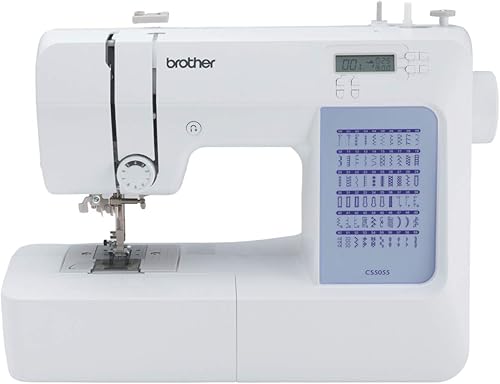
- 60 built-in stitches
- 7 one-step buttonholes
- LCD display
- Metal frame
A computerized machine with 60 stitches and an LCD screen. Best for a beginner who wants plenty of decorative options and an automatic needle threader.
Pros
- 60 built-in stitches cover utility, decorative and heirloom work
- Automatic needle threader and drop-in top bobbin
- Metal frame for stability
- Large needle-to-arm workspace
Cons
- Higher price tier than the CS5055PRW
- Fewer buttonhole styles than its sibling
Its strongest feature is the stitch menu. Sixty stitches span utility seams, decorative patterns and heirloom stitches, and 7 of them are one-step auto-size buttonholes.
For a beginner who wants to try more than straight stitch and zigzag, that's real room to grow.
The LCD display does more than show the stitch number. You use it to adjust stitch length and width for the fabric in front of you, so you can shorten a zigzag for a narrow hem or lengthen a straight stitch for basting.
That feedback loop between screen and fabric is what separates a computerized machine from a dial-based one.
Who the Brother CS5055 suits
Buy the CS5055 if you want a wide stitch menu and a screen without jumping to a premium machine. It fits a beginner who plans to sew garments, home decor and craft projects, and who likes seeing the stitch selection instead of guessing from a dial.
It also suits someone moving up from a basic mechanical machine. The fixed needle bar limits needle movement while you sew, which Brother says gives cleaner stitching and even lines.
That stability matters when you're learning to keep a seam straight.
Skip it if you only need straight stitch and zigzag for simple repairs. You'd be paying for 58 stitches you never use.
In that case the CS5055PRW makes more sense, since its 50 stitches still cover far more than the basics at a lower price tier.
The 4 included bobbins also point to a specific kind of sewer. Someone who switches thread colors often, or who wants to keep a bobbin wound for each common project fabric, gets more value from that kit than someone who sews everything in one thread.
Wind all four at the start and you'll spend less time rewinding mid-project.
Specs that matter in daily use
The 60 stitches and 7 buttonholes are the headline numbers, but daily use comes down to threading and bobbin loading. The automatic needle threader pushes the thread through the needle, and the drop-in top bobbin is jam resistant and easy to load.
Brother builds the frame in metal. That's the part that keeps the machine from walking across the table when you sew thick seams.
The needle bar is fixed in place, so the needle doesn't drift while you work.
The workspace is wider than on many compact machines. A larger needle-to-arm space lets you bunch up a quilt or a curtain panel without fighting the machine.
At 10.5 pounds and about 17 inches wide, it's light enough to move to a table when you need to.
The frame material is metal and plastic together. The metal carries the structure and the plastic covers the housing.
That combination is why the machine stays steady without weighing as much as an all-metal cabinet model.
Setting up the CS5055 for the first time
Set the machine on a sturdy, level table and follow the manual's threading order before you touch a pedal. The LCD display walks you through stitch selection, so you can see what you've chosen as you go.
Load the drop-in top bobbin, then use the automatic needle threader to catch the needle. That's the step that usually frustrates new sewers on mechanical machines, and here it's a press and a release.
Brother includes 7 sewing feet. Start with the all-purpose foot for straight seams and switch to the buttonhole foot when you try the 7 auto-size styles.
The 4 bobbins mean you can keep a few colors wound and ready.
Test each stitch on a scrap of the fabric you plan to use. Stitch length and width are adjustable, so a quick sample tells you more than reading the numbers.
Our threading and setup guide covers the same steps on a related Brother model if you want a second walkthrough.
The first hour with the machine
Plan the first session as a practice run rather than a real project. Thread the top and load the bobbin once without sewing, then repeat it until the order feels natural.
The trilingual manual is written in English, Spanish and French, so keep it open beside the machine and follow one language throughout.
Then run a straight stitch on scrap fabric and check the tension. If the thread loops underneath, the bobbin thread isn't seated in the case.
Rethreading the drop-in bobbin usually fixes it before you touch the tension dial.
The fixed needle bar is the quiet advantage here. On machines where the needle can shift, a beginner fighting tension can also be fighting needle position without knowing it.
With the needle held in place, the variables narrow to thread, bobbin and fabric.
How the Brother CS5055 handles different fabrics
The CS5055 is built to sew thick fabric without stalling, according to Brother. It names denim and tweed as fabrics the feed system can handle, and the metal frame keeps the machine planted while the needle works through the seam.
For light fabrics like cotton and linen, the 60-stitch menu gives you decorative options for hems and trims. The heirloom stitches work well on table linens and children's clothes where you want a finished look.
The 7 one-step buttonholes size themselves to the button you place in the foot. That's a real time saver on shirts and bags, and it means you don't need to measure and mark each buttonhole by hand.
Seven styles means you can match the buttonhole shape to the garment instead of settling for one look everywhere.
Quilting is possible but not the machine's focus. The wider needle-to-arm space helps, but if quilting is your main plan, a model with more quilting-specific feet and a larger throat is the better fit.
Our Brother XR3774 review covers a machine built with quilting in mind.
Care and maintenance for the CS5055
Keep the CS5055 clean and covered and it will keep stitching evenly. Brush lint from the bobbin area after each project, since jam-resistant doesn't mean lint-proof.
A small brush and a drop of machine oil on the points the manual lists go a long way.
Change the needle when it dulls. A fresh needle prevents skipped stitches and protects the timing.
The included needle set gives you spares to start with.
Keep the machine covered when it's not in use to stop dust settling into the bobbin case and feed dogs. Store the feet and bobbins in a small box so they don't scatter.
Brother's 25-year limited warranty and free phone support for the life of the product mean you can call for help with tension or threading problems. Keep your receipt and model number handy.
Our Brother XR9550 review shows how the care routine carries over to a larger computerized model.
One more habit worth building: check the needle plate for scratches and burrs when you change needles. A damaged plate can snag fabric and mimic a tension problem.
The cleaning brush in the accessory kit reaches the feed dogs, and the screwdriver in the kit lets you loosen the plate for a deeper clean when lint builds up.
The trade-offs to know before buying
The main trade-off is price against stitch count. The CS5055 costs more than the CS5055PRW while offering 10 more stitches and 2 more buttonhole styles.
If you won't use decorative stitches, those extras don't earn back the difference.
It's also not a quilting machine. The wider workspace helps with larger projects, but a dedicated quilting model with a bigger throat and more quilting feet does the job better.
If you plan to piece and quilt regularly, look at machines built for that.
The 10.5-pound weight is light for moving, but it also means less mass to absorb vibration than heavier machines. On a sturdy table that's rarely an issue; on a wobbly folding table, expect more shake.
The CS5055PRW weighs 14.8 pounds, so it puts more mass on the table for thick seams.
Finally, the LCD display is basic. It shows your stitch selection and lets you adjust length and width, but it's not a touchscreen or a stitch library with tutorials.
That's fine for beginners and limiting for someone who wants on-screen guidance. The stitch reference is printed on the machine on the Project Runway sibling, while on the CS5055 you rely on the screen and the manual to identify a stitch.
Alternatives worth a closer look
The CS5055 has real competition at this price tier. Three Brother models in particular change the calculus depending on what you sew.
Brother CS5055PRW Sewing Machine
The CS5055PRW is the better value pick overall and carries the higher score of the two. It has 50 built-in stitches and 5 auto-size buttonholes, plus the same automatic needle threader, drop-in top bobbin and LCD display.
It includes 7 sewing feet, a 3-piece needle set, a twin needle and an instruction manual. That's a more complete accessory kit than the CS5055 in some respects, and the lower price tier makes it the smarter first computerized machine for most beginners.
The twin needle alone opens up double-needle hems and decorative twin stitching that a single needle can't produce.
Choose it over the CS5055 if you want to spend less and can live without the extra 10 stitches. The 50 stitches still cover utility, decorative, heirloom and quilting functions.
It also ships with a ball point needle and a seam ripper, so the kit covers knit fabrics and mistake recovery from day one.
Brother ST371HD Sewing Machine
The ST371HD is a heavy-duty mechanical option for sewers who work with thick fabric more than decorative stitches. It skips the LCD screen and computer controls in favor of a sturdy build for tough materials.
If you sew denim, canvas or upholstery regularly, a mechanical heavy-duty machine often handles those seams with fewer complaints than a computerized model. The trade-off is a smaller stitch menu and no screen.
Brother XR3774 Sewing and Quilting Machine
The XR3774 is the quilting-focused alternative. It's built with quilting in mind and comes with quilting feet, which the CS5055 lacks.
For a sewer who wants to piece and quilt, this is the better starting point.
The CS5055's wider workspace helps, but quilting machines carry the feet and accessories you'll actually use. If quilting is the goal, start here.
Our Brother SQ9285 sewing machine reviews cover another quilting-capable model if you want more options.
Brother XR9550 Sewing and Quilting Machine
The XR9550 is the step up for sewers who want more. It's a larger computerized machine with a broader stitch menu than the CS5055.
For a sewer who has outgrown a beginner machine, this is the natural upgrade.
The verdict on the Brother CS5055
The Brother CS5055 is a capable beginner machine, but the CS5055PRW is the better buy for most readers. The PRW carries a 9.3 score against the CS5055's 8.3, costs less, and shares the threading, bobbin and screen features that make these machines easy to learn on.
Pick the CS5055 if 60 stitches and 7 buttonhole styles matter to you. The extra decorative options suit craft sewing and garment work where you want variety.
Pick the CS5055PRW if you want the same smooth setup for less money and can live with 50 stitches.
If quilting or heavy fabric is your focus, neither is the right first machine. Go to the XR3774 for quilting or the ST371HD for thick materials.
Those brother cs5055 sewing machine reviews come down to one clear choice: the CS5055PRW is the best overall pick here, and the CS5055 is the one to buy when the stitch menu is the reason you're shopping.
Frequently asked questions
What is the difference between the Brother CS5055 and the CS5055PRW?
The CS5055 has 60 built-in stitches and 7 one-step buttonholes. The CS5055PRW has 50 stitches and 5 auto-size buttonholes.
Both are computerized machines with an LCD display and an automatic needle threader, so the stitch count is the main difference.
Is the Brother CS5055 good for beginners?
Yes. The automatic needle threader and drop-in top bobbin remove two of the fiddliest setup steps, and the LCD display shows your stitch selection without guesswork.
The 60-stitch menu leaves room to grow past plain seams.
Can the Brother CS5055 sew thick fabric like denim?
Brother says the feed system handles denim, tweed and other thick fabrics. The metal frame keeps the machine steady while you sew.
Use the right needle and foot for the fabric, and test on a scrap piece first.
What accessories come with the Brother CS5055?
The CS5055 includes 7 sewing feet, 4 bobbins, a needle set and a trilingual English, Spanish and French user manual. That covers the everyday feet most beginners need without buying extras at the start.
How much space does the Brother CS5055 take up?
It measures about 17 inches wide, 12 inches high and 7 inches deep, and weighs 10.5 pounds. The needle-to-arm space is wider than on many compact machines, which helps when you sew larger projects.
What warranty does the Brother CS5055 come with?
Brother backs it with a 25-year limited warranty plus free phone and technical support for the life of the product. Keep your receipt and model number, and read the coverage terms before you buy.