7 Best Brother Sewing Machines for Beginners (October 2026)
The best Brother sewing machines for beginners include the Brother XM2701 for a versatile first machine, the Brother XM3700 for extra stitch choices, and the Brother CS5055 for a larger needle-to-arm workspace.
On this page (5 sections)
The Brother XM2701 is the best Brother sewing machine for most beginners, with an automatic needle threader, drop-in bobbin and 27 stitches for everyday projects. Choose the SM1400 for fewer stitch choices, the CS5055 for a larger needle-to-arm workspace, or the XR3774 if quilting is on your list.
A beginner machine should make setup manageable and handle the projects you plan to sew. These Brother models range from dial-selected stitches to a computerized machine with an LCD display and a larger stitch menu.
For more help choosing a first machine, read our guide to picking the best sewing machine for your home. If you're deciding between two Brother options, compare the XM2701 and GX37.
Our picks at a glance
-
1

-
2

-
3
Which Brother sewing machine for beginners fits each need?
The XM2701 is the best all-round starting point, while the other machines suit preferences such as a larger needle-to-arm workspace, dial-selected stitches or quilting accessories. Match the features to your first projects rather than choosing by stitch count alone.
Brother XM2701: Best for a versatile first machine
- 27 built-in stitches
- Automatic needle threader
- Jam-resistant drop-in top bobbin
- Free arm
The XM2701 combines threading aids with everyday and decorative stitches. Its free arm and 6 included feet offer options for common sewing tasks.
Pros
- Automatic needle threader
- Drop-in top bobbin
- 6 sewing feet
Cons
- Intended for sale and use in the US at 120 volts
The XM2701 is suited to basic clothing repairs, simple projects and practice with different stitch types. It has 27 built-in stitches, including decorative, blind hem, zigzag and stretch stitches, plus an auto-size buttonhole.
The automatic needle threader and jam-resistant drop-in top bobbin help with setup. The free arm gives you access to cuffs, sleeves and pant legs.
Six included sewing feet offer options for tasks such as zippers, buttonholes and blind hems. Brother offers technical support online, by live chat or phone for the life of the machine.
The XM2701 is intended for sale and use in the US at 120 volts. Read the instructions before sewing, and practice on scrap fabric while you learn stitch selection and tension.
Brother XM3700: Best for extra stitch choices
- 37 built-in stitches
- Automatic needle threader
- Drop-in top bobbin
- Free arm
The XM3700 has 37 stitches and beginner-friendly threading features. Its free arm suits smaller cylindrical items such as cuffs and sleeves.
Pros
- 37 built-in stitches
- Automatic needle threader
- One-step buttonhole
Cons
- Intended for sale and use in the US at 120 volts
The XM3700 suits a beginner who wants more stitch options with threading features. Its 37 built-in stitches include decorative and blind stitch options, along with a one-step auto-size buttonhole.
It includes an automatic needle threader and jam-resistant drop-in top bobbin. Five sewing feet cover zigzag, zipper, blind stitch, buttonhole and button sewing, while the free arm helps with small cylindrical items such as cuffs and baby clothes.
The XM3700's stitches suit garment construction, decorative stitching and quilting. If you mainly need a machine for occasional repairs, the XM2701 or SM1400 offers a smaller set of choices.
The machine is intended for sale and use in the US at 120 volts. Check that your power supply matches before setting it up.
Brother CS5055: Best for a larger needle-to-arm workspace
- 60 built-in stitches
- LCD display
- 7 one-step auto-size buttonholes
- Larger needle-to-arm workspace
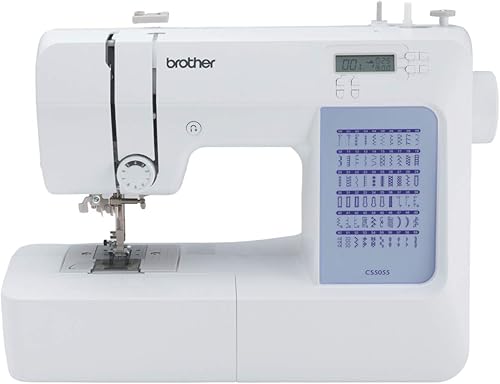
The CS5055 has 60 stitches, an LCD display and a larger needle-to-arm workspace for larger projects. Its computerized controls give beginners a broad set of options.
Pros
- 60 built-in stitches
- LCD display
- Larger needle-to-arm workspace
Cons
- Intended for sale and use in the US at 120 volts
The CS5055 suits beginners who want computerized stitch selection and room for larger pieces. It has 60 built-in stitches, an LCD display and 7 one-step auto-size buttonholes.
Its larger needle-to-arm workspace provides more room beside the needle for larger projects. Seven sewing feet and a jam-resistant drop-in bobbin add practical options, while the automatic needle threader helps with setup.
The fixed needle bar stays in place while you sew, allowing for cleaner stitching and even lines. The machine is intended for sale and use in the US at 120 volts.
For more stitch guidance, see our guide to sewing machine stitch types. More stitch options can be useful, but beginners can make many projects with a small set of basic stitches.
Brother XR3774: Best for beginner quilting projects

- 37 built-in stitches
- Wide table
- 8 sewing feet
- Automatic needle threader
The XR3774 includes a wide table and 8 sewing feet for beginners who plan to try quilting as well as everyday sewing. It also has an automatic needle threader and drop-in top bobbin.
Pros
- Wide table included
- 8 sewing feet
- Automatic needle threader
Cons
- Intended for sale and use in the US at 120 volts
The XR3774 suits a beginner who wants to learn quilting as well as everyday sewing. Its wide table supports larger pieces, and its 37 built-in stitches include quilting and blind hem options.
Eight sewing feet provide options for different tasks. The automatic needle threader and drop-in top bobbin help with setup, and the free arm suits sleeves, cuffs and other cylindrical pieces.
The included machine cover and instructional DVD may be useful if you plan to store the machine between sessions or prefer video guidance. The XR3774 is intended for sale and use in the US at 120 volts.
A wide table takes extra room. Measure your sewing surface and storage area before choosing this model.
Brother SM3701: Best for a mechanical-style setup

- 37 built-in stitches
- One-step auto-size buttonhole
- 5 quick-change feet
- Free arm
The SM3701 has 37 stitches, 5 quick-change feet and a free arm for cuffs and sleeves. Its stitch selection and instructional DVD offer a starting point for learning.
Pros
- 37 built-in stitches
- One-step buttonhole
- Free arm
Cons
- Intended for use at 120 volts in the US
The SM3701 offers 37 stitches in a lightweight machine with a free arm. It has a one-step auto-size buttonhole and 5 quick-change feet, including zipper, blind stitch and button sewing feet.
An automatic needle threader and drop-in top bobbin help with setup. The instructional DVD can also help when you're learning its controls and threading path.
Consider it if you want a useful range of stitch functions but don't need an LCD display. The free arm suits cuffs and sleeves, and the SM3701 includes an instructional DVD and English and Spanish user manual.
Brother FB1757X: Best for a simple mechanical machine

- 17 built-in stitches
- Four-step buttonhole
- Reverse button
- Free arm
The FB1757X has 17 built-in stitches and a four-step buttonhole. Its reverse button and free arm provide basic controls and help with smaller cylindrical projects.
Pros
- 17 built-in stitches
- Reverse button
- LED work area lighting
Cons
- Four-step buttonhole
The FB1757X has 17 built-in stitches and a four-step buttonhole. A reverse button, free arm and LED work area cover several basics beginners use while learning.
This mechanical machine may suit you if you prefer a simpler set of functions over a large computerized stitch menu. Its free arm helps with sleeves and other small cylindrical items.
The four-step buttonhole takes more steps than the one-step buttonholes on the XM2701, XM3700, CS5055 and SM3701. That may suit occasional buttonholes, but consider how often you expect to make them.
Brother SM1400: Best for everyday mending

- 14 built-in stitches
- Dial stitch selection
- Four sewing feet
- Free arm
The SM1400 has 14 built-in stitches selected by dial for everyday sewing and mending. Its free arm, needle threader and four feet cover common beginner tasks.
Pros
- Dial stitch selection
- Free arm
- 4 quick-change feet
Cons
- Four-step buttonhole
The SM1400 is aimed at everyday sewing and mending, with 14 built-in stitches selected by turning a dial. Its four included feet cover general sewing, zippers, buttonholes and button sewing.
The free arm helps with cuffs and sleeves. The machine also includes an automatic needle threader, drop-in top bobbin, an instructional DVD and an English and Spanish user manual.
Choose the SM1400 if you want a smaller stitch menu and straightforward dial selection. Its four-step buttonhole takes a few steps, so compare it with the one-step options if buttonholes are a frequent project.
How we chose beginner Brother sewing machines
We compared the stitch options, threading aids, bobbin style, included feet and features for common first projects. Our score weighs specs, features and buyer feedback against what you're shopping for.
Threading help and a drop-in bobbin can make setup less fiddly, but they don't replace practice with the manual. A free arm helps with sleeves and cuffs, while a wide table or larger needle-to-arm workspace can matter more for broad fabric.
A high stitch count isn't automatically a better fit. If you expect to sew repairs and simple items, a smaller menu may be easier to learn; if you want decorative work or quilting, additional stitch choices and workspace can be useful.
What should you compare before choosing a Brother beginner machine?
Start with the projects you want to make, then compare setup aids and controls. A machine for hemming pants may need different features than one you plan to use for quilting or garment construction.
How many stitches does a Brother sewing machine for beginners need?
A beginner can start with a modest stitch selection, since many basic seams use straight and zigzag stitches. The SM1400 has 14 built-in stitches, while the XM2701 has 27 and the CS5055 has 60.
Choose a larger menu when you have a clear use for decorative, stretch, blind hem or quilting stitches. Our sewing machine stitch length guide explains another setting that affects how seams look and behave.
Which threading features help most?
An automatic needle threader can help pass thread through the needle, and a drop-in top bobbin is easy to see as you place it. The XM2701 and XM3700 combine both features.
Setup still depends on following the correct thread path and winding the bobbin properly. Use our Brother threading walkthrough and bobbin winding guide before your first seam.
Do you need a free arm or a wide table?
A free arm helps when sewing around narrow pieces such as cuffs and sleeves. All seven picks list a free arm, making it useful for clothing repairs and small projects.
A wide table or larger needle-to-arm workspace matters more for broad fabric. The XR3774 includes a wide table, and the CS5055 has a larger needle-to-arm workspace, both useful considerations for beginners interested in quilting.
Should you choose a mechanical or computerized machine?
Choose based on the controls you find easier to learn. The FB1757X and SM1400 have smaller stitch selections, while the CS5055 has an LCD display and a broader computerized menu.
A straightforward machine can still have useful setup aids. Compare the controls, buttonhole steps and included feet, then read our easy-to-use sewing machine guide for more options.
How to get started with your first Brother machine
Read the manual before threading or changing a presser foot, then practice on scrap fabric. Begin with a straight seam, test reverse stitching and learn how to wind and insert the bobbin before starting a garment or home project.
Check your needle and thread when stitches look uneven or fabric puckers. Our needle size chart can help match a needle to fabric, and our presser feet guide explains what the included feet are for.
Which Brother sewing machine for beginners should you choose?
Pick the XM2701 for a versatile first setup, the SM1400 for dial-selected everyday sewing, or the CS5055 for a larger needle-to-arm workspace and wide stitch menu. Choose the XR3774 if quilting is part of your plan and its wide table would help.
If you have a specific Brother model in mind, compare it with the XM2701 vs GX37 guide before deciding. Make sure a machine's 120 V requirement fits your location.
Our top 3 picks at a glance
-
1
-
2
-
3
Frequently asked questions
Which Brother sewing machine is easiest for a beginner?
The Brother XM2701 is a strong first choice because it has an automatic needle threader, a drop-in top bobbin and 27 built-in stitches. If you'd rather start with fewer stitch choices, the SM1400 has 14 stitches selected by dial.
Both include a free arm for sewing cuffs and sleeves.
Do beginners need a sewing machine with many stitches?
No. Many first projects use straight, zigzag and stretch stitches, so stitch count matters less than clear controls and threading help.
The SM1400 has 14 built-in stitches, while the CS5055 has 60.
Extra options can be useful for decorative work or different projects.
Is an automatic needle threader useful for a beginner?
An automatic needle threader can help guide thread through the needle and may make setup easier. The XM2701, XM3700, CS5055, XR3774 and SM1400 include one.
Follow the machine's threading path and check the manual if the thread doesn't catch.
Can a beginner use a Brother sewing machine for quilting?
Yes, a beginner can learn quilting on a suitable home sewing machine. The XR3774 includes a wide table and quilting stitches, while the CS5055 has a larger needle-to-arm workspace.
Start with small practice pieces and check the manual for suitable setup and accessories.
What should a beginner learn first?
Begin with threading, winding and inserting the bobbin, then practice straight seams on scrap fabric. Learn the reverse control and how to change the presser foot before moving to clothing or larger projects.
Our step-by-step guides cover threading a Brother machine and first-day sewing machine basics.